PCB and PCBA
A PCB is the bare circuit board. PCBA is that board with its components placed and soldered, ready to go into the product.
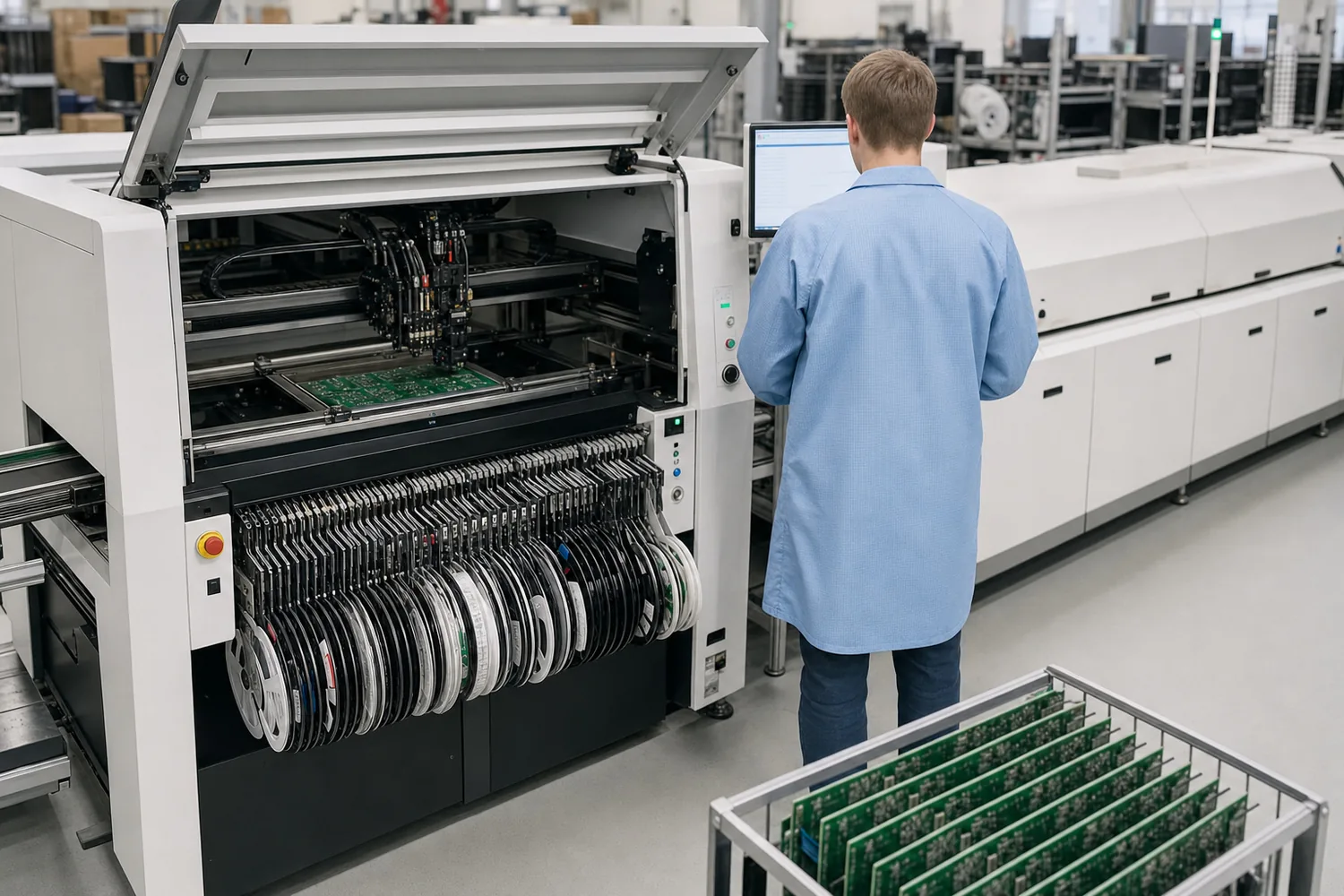
What the work includes
- Your board files. We build from your board files. If the board needs design work, we quote it separately.
- Board fabrication. The bare board is made from your fabrication files (Gerber or ODB++).
- SMT and through-hole assembly. Solder paste is printed through a stencil, then surface-mount parts are placed by machine, reflow-soldered and checked by automated optical inspection. Through-hole parts such as connectors are soldered after.
- Programming and functional test. Each board is loaded with your firmware and tested on a fixture against pass and fail checks agreed with you, before it goes into the product.
What it makes and when to choose it
Custom boards, assembled and tested.
Choose it when a prototype that runs on a development board has to move to a custom board for production. Decide early who buys the components: you, or the assembler.
Common materials
FR-4 boards
Frequently asked questions
Can you sell a product with an Arduino or ESP32 dev board inside?
Yes. An unmodified Arduino board inside a product doesn't require you to publish your design, though you can't use the Arduino name for your product. But a dev board rarely makes a good product: it's too big for most cases, draws too much power asleep, and is slow to program and test on a production line.
What's the difference between turnkey and consigned assembly?
In turnkey assembly, the assembler buys every part, chases shortages and inspects parts on arrival, adding a markup to the parts it buys. In consigned assembly, you buy the parts, ship them in as a kit and carry those risks. Partial turnkey splits the list. For a first run of a few hundred to a few thousand units, turnkey is the usual choice.
If I use an FCC-approved Bluetooth module, does my product still need FCC testing?
Yes. A module that already holds FCC approval saves most of the radio testing if you use it exactly as its approval allows, but the finished product still needs its own FCC emissions testing as a digital device (Part 15 Subpart B). If the module's FCC ID isn't visible, the label must say "Contains FCC ID: …".
Other processes
We work fromSTEP · IGES · STL · Drawings · Photos
Tell us what you're building and how many you plan to make.
A real person on our team will reply with a first look at your production run and a few times to talk.
Free first look. We reply within two business days. Sending a request doesn't commit you to a project.