What you get, step by step
From your working prototype to units in your warehouse. Once the production review starts, you decide at four points; we run the rest.
- 1 Request
- 2 Call
- 3 Production review You decide: Go or stop, how many
- 4 Production design You decide: Start tooling
- 5 Tooling You decide: Approve the sample
- 6 Pilot run You decide: Approve production
- 7 Production and delivery
Watch how a request becomes a production plan 1:35
-
1
Request
We read your request and look up what is public about your product.
You get: A free first look at your production run within two business days, and a few times to talk.
-
2
Call
We hear what you are making, where it is stuck, how many you need and by when.
You get: What it takes to bring your product to production, and typical cost ranges for runs like yours.
You decide: Whether to start a production review.
-
3
Production review
We review your design for production, get quotes from partner factories for each process, and plan the run.
You get: A rendering, an exploded view, a quote by quantity, and a production timeline.
Price: The first paid step. We agree the price in writing before we start.
You decide: Go or stop, and how many.
What a production review looks like
Fictional sample FS-1 — not a real customer product. A hands-free headset that clips onto a technician's hard hat, taken through step 3.
See the FS-1 example page for an exploded photo and the assembly video →
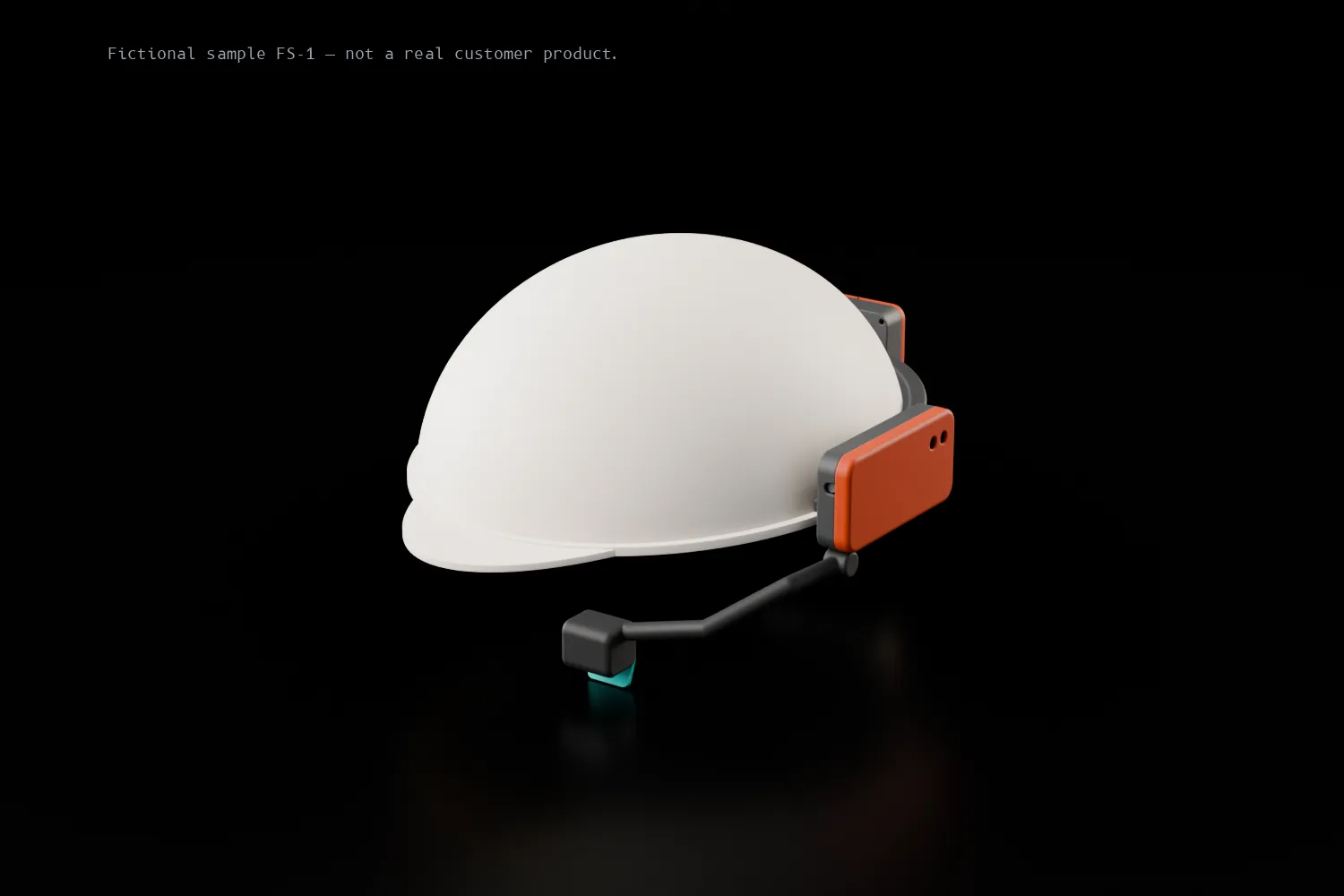
Rendering. The finished product, rendered from the CAD model. 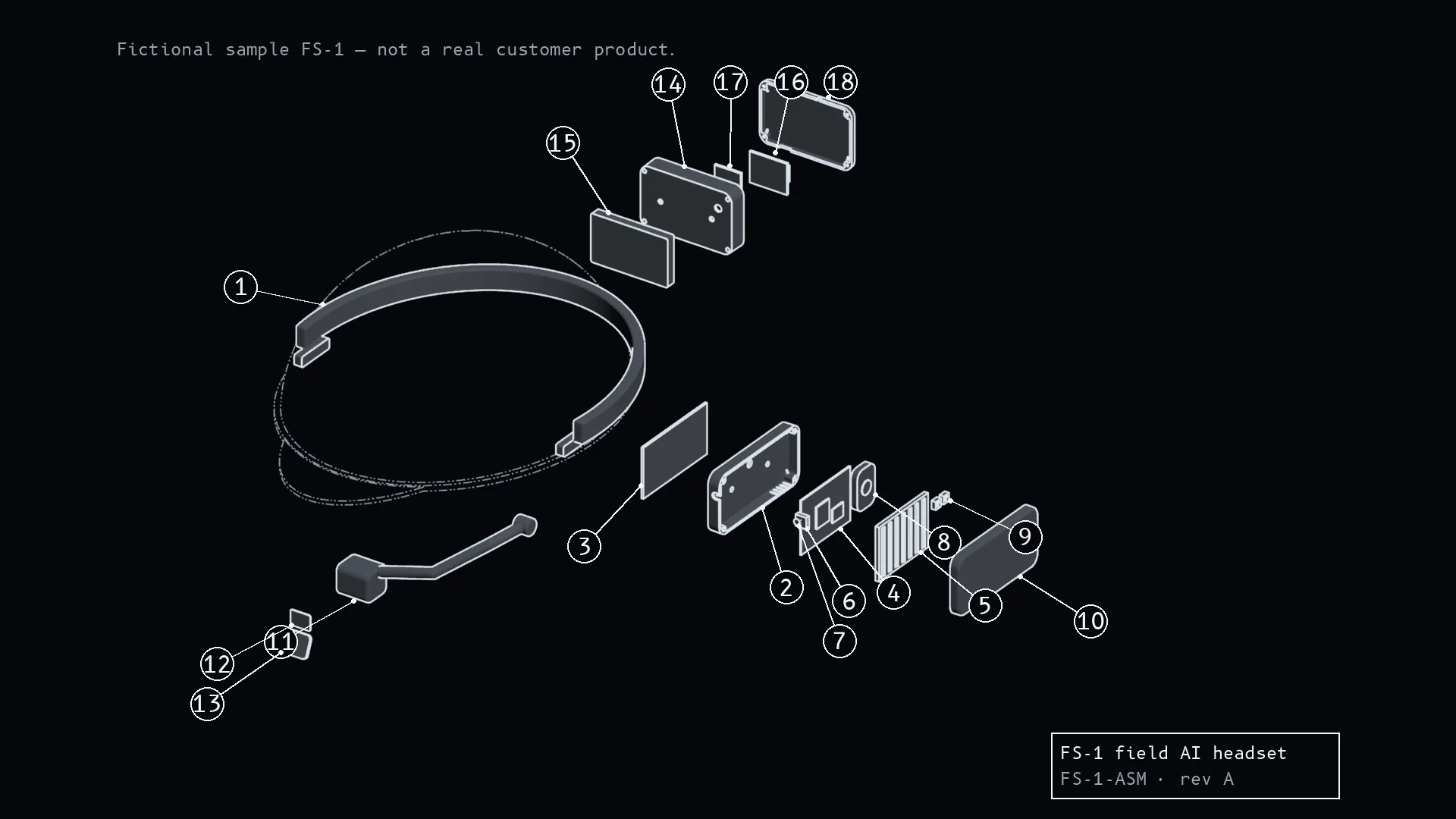
Exploded view. Every part, numbered, and how each one is made. No. Part Qty Made by 1 Halo band with slot clips 1 3D printed 2 Module base 1 Molding 3 Carrier board 1 PCBA 4 Compute module 1 Bought module 5 Heat spreader 1 Bought, aluminum 6 Camera module 1 Bought module 7 Camera lens 1 Bought 8 Speaker 1 Bought 9 Button switch 2 Bought 10 Module cap 1 Molding 11 Fold-down display arm and pod 1 3D printed, display bought 12 Display window 1 Bought 13 Tinted eyepiece 1 Bought 14 Battery pod base 1 Molding 15 Battery 1 Bought 16 Charger board 1 PCBA 17 USB-C charging board 1 PCBA 18 Battery pod cap 1 Molding Quote by quantity · FS-1 hands-free headset
Example figures
From the FS-1 brief: 300 units first, then about 3,000 a year. The quote runs that plan on the path we suggest; the table under it prices the same plan with steel from the start.
Line 1 · First 300 units 2 · Then 3,000 a year Housings made by Aluminum molds Steel molds First units at your warehouse Week 16 Week 37 One-time before each run Housing molds, 4 parts $15,125 $22,000 Board stencils and test fixtures, 3 boards $2,255 — Production board test build, 5 sets $2,040 — Assembly line and box setup $2,400 $600 Certification (FCC Part 15B), if you need it $1,800 — One-time total $23,620 $22,600 Per unit before shipping Housings, 4 parts $6.90 $3.45 Compute module, camera and display $323.84 $273.24 Boards: carrier, charger, USB-C $29.10 $19.61 Battery, speaker, buttons, cables, seals $21.25 $15.94 Band and display arm, printed $32.89 $29.10 Box, guide and cable $6.33 $2.78 Assembly, test and packing $14.00 $10.40 Scrap allowance, 2% $8.69 $7.09 Unit price before shipping $443.00 $361.61 Per unit delivered to your US warehouse Freight, duty and customs $10.05 $1.90 Landed cost per unit $453.05 $363.51 Whole run delivered to your US warehouse Total for the run $159,535 $1,113,130 Per unit, all in $531.78 $371.04 The same plan, two ways to tool
Line Aluminum for the first 300, then steel (suggested) Steel from the first 300 Molds for the first 300 $15,125 $22,000 Molds in all, by the 3,000 run $37,125 $22,000 First 300 at your warehouse Week 16 Week 19 Both runs, delivered $1,272,665 $1,257,540 If the first 300 change the design The steel molds are cut once, to the settled design The steel molds are reworked, at extra cost and weeks Why we suggest aluminum first
- The splash test, the module's surface temperature and the buttons under gloves are still to be run, so the first 300, in a field trial at two plants, will likely change the housings.
- Aluminum molds take those changes cheaply, and the steel molds are cut once, to the settled design.
- The first 300 reach the two plants about three weeks sooner.
- If the design is already settled, steel from the start costs about $15,100 less in molds.
- — in the 3,000-a-year column: paid with the first 300 and reused.
- Duty: 0% at entry (HTS 8517.62, made in Korea), checked Oct 28, 2026.
- We assume Wi-Fi runs on a radio module with its own FCC approval, such as the compute module's, so the FCC test is Part 15B with a radio spot check.
- Assembly, test and packing: 35 and 26 minutes a unit.
- To test demand before any molds, urethane-cast housings add $14,025 in silicone molds and about $25 per unit to the first 300.
- Battery: 7.4 Wh cells with UN38.3 test reports, so units ship by air or sea without full dangerous-goods handling.
What can move these numbers
- Compute module and display: about 66% of the parts, and their prices and lead times follow supplier stock.
- Resin: a chemical-resistant grade for refinery use, such as a glass-filled one, wears aluminum molds faster and points to steel from the start.
- Hard hats: the band clips into the accessory slots of the hat models you name; each new model needs a fit check.
Quote by quantity. Setup costs and unit prices at each quantity, delivered to your US warehouse. Production timeline · first 300 on aluminum molds, then 3,000 a year on steel
Example figures
Weeks from your go04812162024283236Design for productionYou start tooling week 3Aluminum molds, trial shots, one fixYou approve the sample from photos week 9Board test build, then PCBAPilot run, flown to you to tryYou approve production week 14First 300 units, by airField trial at two plantsSteel molds to the settled design, two fixesYou approve the steel sample week 293,000 run: build, test, packShip to the US by sea, customsCertification, if you need itLongest pathRuns alongsideIf you need itYou decide
- Steel from the first 300: steel molds take about two weeks longer and usually a second fix, so the first 300 arrive around week 19; the 3,000 run can follow once the field trial is done.
- A factory holiday inside tooling, such as Lunar New Year in early February, adds about a week.
Production timeline. Week by week from your go, with the points where you decide. -
4
Production design
We finish the design for production, from enclosure to PCB. The factory reviews it and firms up the tooling quote.
You get: The firm tooling quote, and the changes the factory asked for.
You decide: Start tooling.
-
5
Tooling
We make the molds and run trial shots, fixing them round by round.
You get: Photos and measurements from each round, and photos of the appearance sample to approve.
You decide: Approve the sample.
-
6
Pilot run
We build a first batch: parts, assembly and quality checks.
You get: The first assembled units, flown to you to try, with the first article inspection report and the assembly QC results.
You decide: Approve production.
-
7
Production and delivery
We produce, inspect, pack and ship.
You get: Inspection results for each lot, and units at your warehouse.
After launch, reorders and defect reports go through us, and we handle them with the factory.
How you follow the work
At every step you get the photos and results from that step, and we tell you what is with whom: you, us or the factory.
Certification and firmware
Certification testing, if you need it: arranged through accredited labs and itemized in your quote. Your firmware stays yours; we flash it on the line.
Tell us what you're building and how many you plan to make.
A real person on our team will reply with a first look at your production run and a few times to talk.
Free first look. We reply within two business days.