Hands-free headset for field technicians
Fictional sample FS-1 — not a real customer product. An AI headset that clips onto a worker's own hard hat: two printed housings redesigned for injection molding, ready for a 300-unit pilot run.

- Process
- Printed prototypes → Injection
- Quantity
- 300 pilot → 3,000 a year
- Region
- US
- Environment
- Refineries and sites, outdoor
- Image
- Concept image, not to scale
Example brief · not client workWe wrote this brief ourselves; it is not client work. The design below starts from the founder's printed prototype: we redesigned its two housings for injection molding. The bought parts are simple blocks, and the band, the display arm and the hard hat are rough shapes. It has not been built or tested physically.
The request, as a client would send it
Fictional sample FS-1 — not a real customer product. I'm a solo hardware founder in the US. FS-1 is a hands-free AI assistant for field technicians in refineries, chemical plants and on construction sites. It clips onto the technician's own hard hat. A small display folds down in front of the right eye, a camera looks where they look, and they talk to it. Today they juggle a phone, a radio and a paper binder with gloves on. I hand-built 10 units and two plants have used them on day shifts for six weeks. Everything is 3D printed. The electronics sit in two housings: a module on the right side of the hat (compute, camera, speaker, two buttons) and a battery pod on the back. A printed band runs around the outside of the hat between them and clips into the hat's side accessory slots, the ones used for earmuffs. Each housing is a cap and a base held by four small screws that bite straight into the plastic. It works, but I can't make it in volume. Next is a pilot run of 300 units, then about 3,000 a year. I expect the two housings to move to injection molding in PC/ABS. - The hard hat carries the weight, not the head or the ears, and nothing gets in the way of the chin strap. Under 200 g with the battery. - Splash and dust resistant (aiming at IP54): it rains on site and the plants are dusty. - The two buttons must be easy to find and press with work gloves on. - The camera sees what the technician sees, and the display folds up out of the way. - The speaker must be heard at about 85 dBA, and the module must not get uncomfortably warm on a hot day. - Not for explosive (hazardous) areas in this version. The carrier board is my own design and I'd rather not redo it. The band, the display arm and the display pod stay as they are for now. Other boards can be swapped for similar ones.
Attached by the client
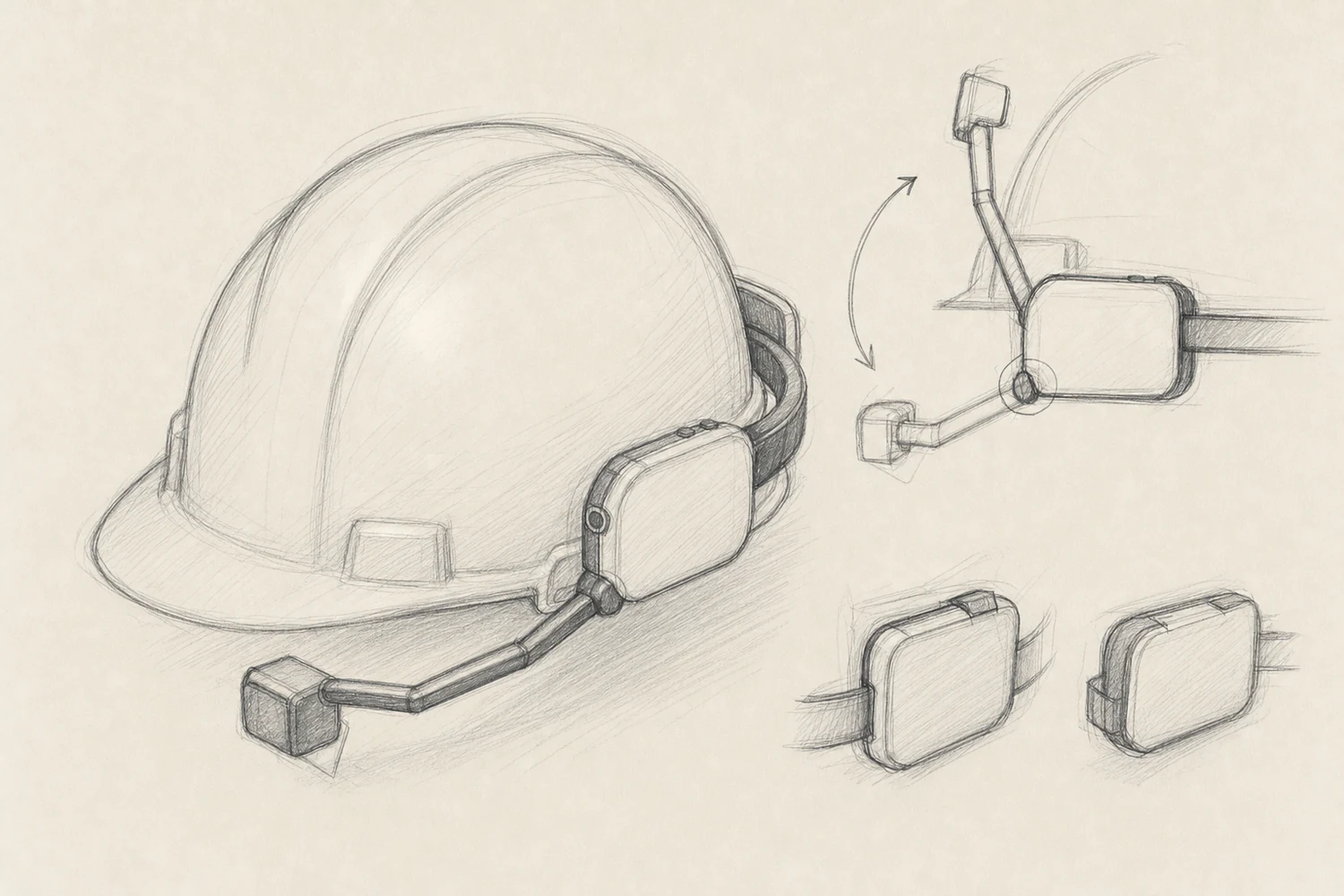
Links in the request
- Raspberry Pi Compute Module 5 (opens in a new tab)55 x 40 x 4.7 mm
- Adafruit 2000 mAh LiPo battery (opens in a new tab)60 x 36 x 7 mm
- IP code (IEC 60529) (opens in a new tab)What IP54 means: dust protected, splash resistant
Product names are their owners' trademarks and are used only to describe size or parts.
Highlighted numbers came with the request; they are the values we would design to.
What we considered
| No. | Consideration | How it is checked |
|---|---|---|
| 01 | Ready for the mold Both housings get draft on every wall, ribs on the screw bosses, rounded inside corners, and side openings reshaped so the mold opens without sliding parts. | Each housing piece against the molding rules; draft angles and wall thickness listed. |
| 02 | The hat carries it The module sits on the right end of the band above the ear and the battery pod on the back, so the weight rests on the hat and nothing touches the ears or the chin strap. | Every part checked for overlap where it sits when worn, the band and the display arm included. |
| 03 | Buttons for gloved hands Two 6 mm buttons on the outer face of the module, where a gloved finger finds them by feel. | Button holes and their place on the module cap; pressing them with gloves is not tested yet. |
| 04 | Rain, dust and a warm compute board Few, small openings in the housings, and an aluminum heat spreader on the compute board under the cap. Sealing for IP54 comes next. | Openings listed; the IP54 test and the module's surface temperature are not run yet. |
The question we would ask you
Keep the printed band and display arm, or redesign them for molding too?
Molding them would make them stronger and cheaper at 3,000 a year, but it needs new tools and a new fit to each hard-hat model's side slots.
What we do not claim
- IP54 or any certification
- Use in explosive (hazardous) areas
- Weight and battery life measured on a built unit
Sample CAD and the checks we ran
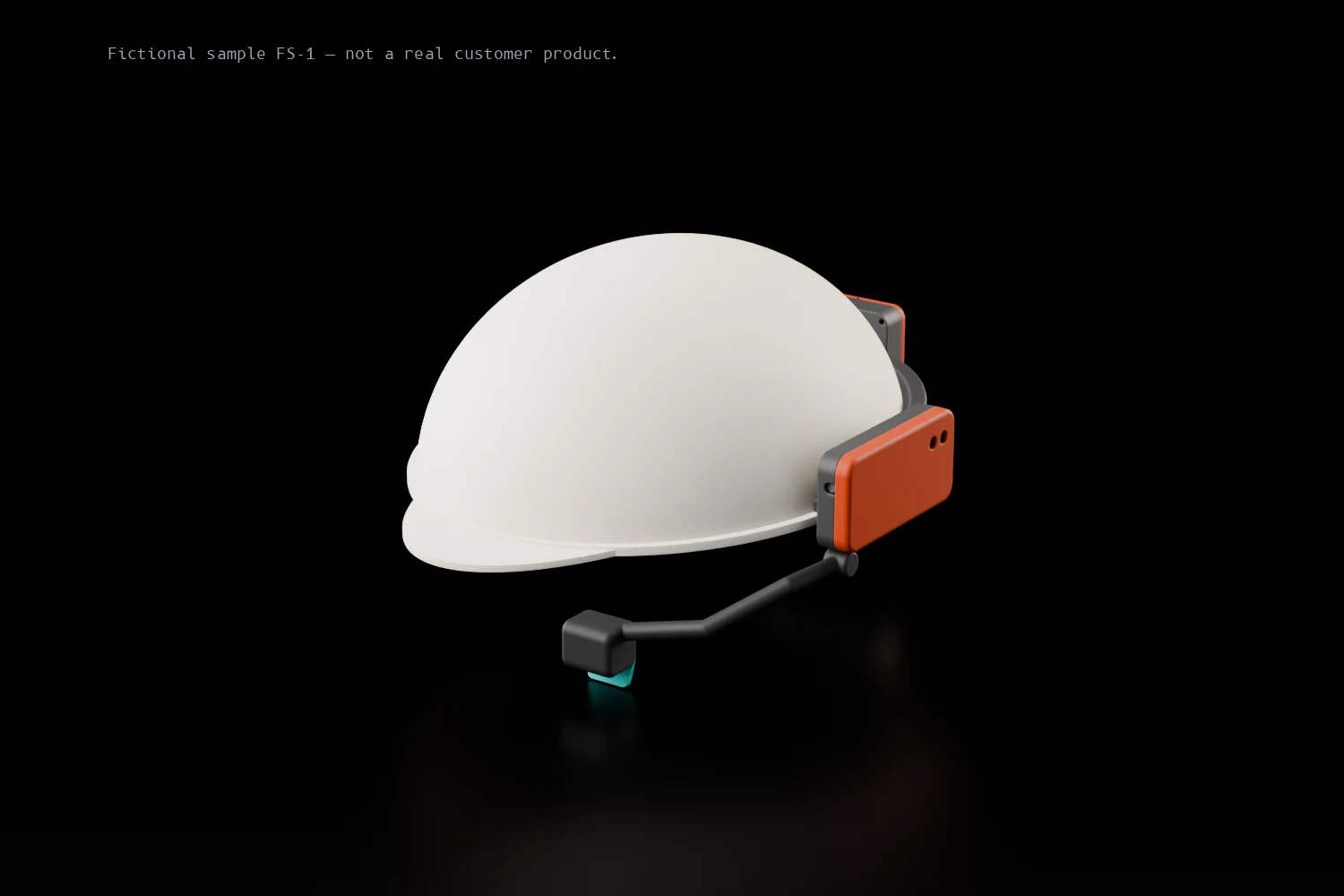
Sample designFictional sample FS-1 — not a real customer product. The four housing pieces are Anamor's redesign of the founder's printed prototype for injection molding. The bought parts are simple blocks at their listed sizes, and the band, the display arm and the hard hat are rough shapes. It has not been built or tested physically.
P15-ASM
- 1Halo band with slot clips
- 2Module base
- 3Carrier board
- 4Compute module
- 5Heat spreader
- 6Camera module
- 7Camera lens
- 8Speaker
- 9Button switch×2
- 10Module cap
- 11Fold-down display arm and pod
- 12Display window
- 13Tinted eyepiece
- 14Battery pod base
- 15Battery
- 16Charger board
- 17USB-C charging board
- 18Battery pod cap
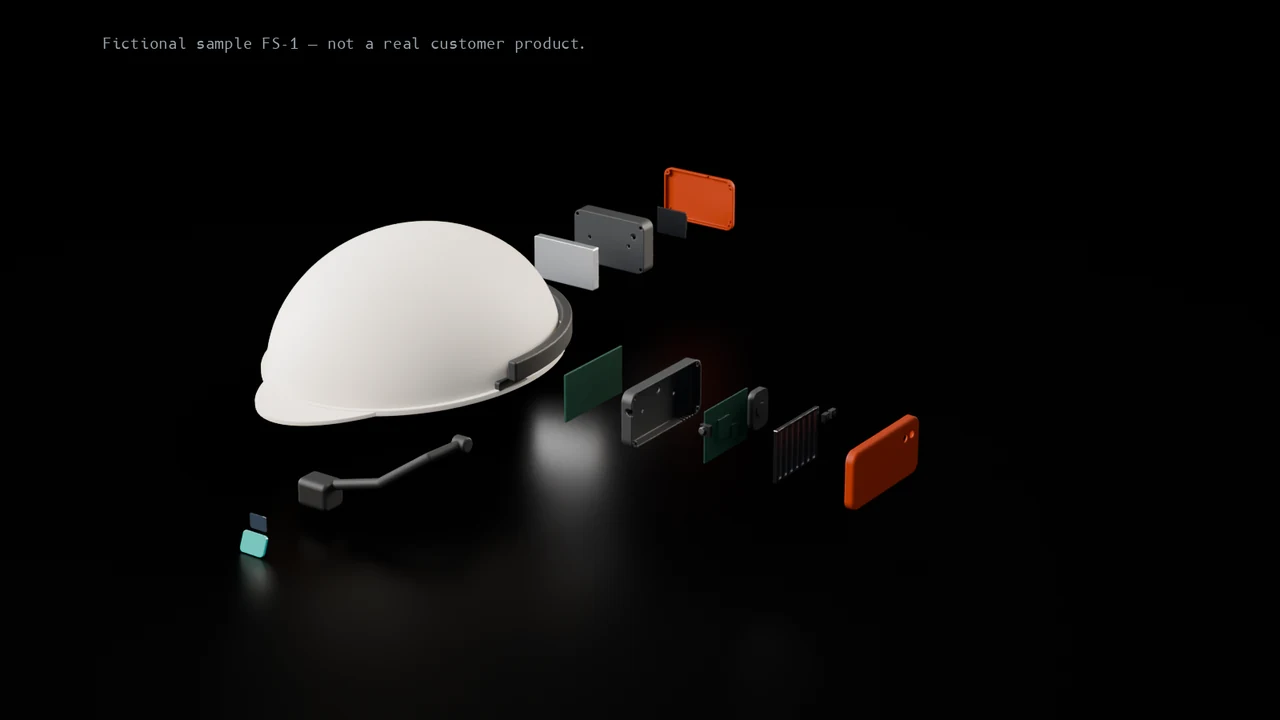
Parts list · 19 parts
| No. | Part | Qty |
|---|---|---|
| 1 | Halo band with slot clips | 1 |
| 2 | Module base | 1 |
| 3 | Carrier board | 1 |
| 4 | Compute module | 1 |
| 5 | Heat spreader | 1 |
| 6 | Camera module | 1 |
| 7 | Camera lens | 1 |
| 8 | Speaker | 1 |
| 9 | Button switch | 2 |
| 10 | Module cap | 1 |
| 11 | Fold-down display arm and pod | 1 |
| 12 | Display window | 1 |
| 13 | Tinted eyepiece | 1 |
| 14 | Battery pod base | 1 |
| 15 | Battery | 1 |
| 16 | Charger board | 1 |
| 17 | USB-C charging board | 1 |
| 18 | Battery pod cap | 1 |
What we measured on the sample
- Fit at rest
- 0 of 171 pairs overlapEvery pair of the 19 parts checked where they sit when worn. The band's clips sit in the hard hat's side slots on purpose.
- Fit problems fixed in the redesign
- 8 found, 0 leftThe first redesign had 8 places where the housings, their screws, the band cable and the room kept for the band and the display arm ran into each other. The second moved the cable holes beside the band and cleared all 8.
- Draft for the mold
- 1.5° walls, 1° bossesEvery side wall of the four housing pieces tapers 1.5° so it leaves the mold; screw bosses, ribs and holes taper 1°. The printed prototype had none.
- Housing sizes
- 90 × 44 × 16 and 72 × 46 × 18 mmRight-side module and battery pod. Worn, the whole kit spans 242 × 269 × 110 mm around the hat.
Not done yet
- Weight against the 200 g target
- Splash and dust test (IP54)
- Temperature of the module on a hot day
- A physical build