Stretchable-conductor glove demo
A glove that shows a lab's stretchable conductor at work: five finger traces read by a wrist module.
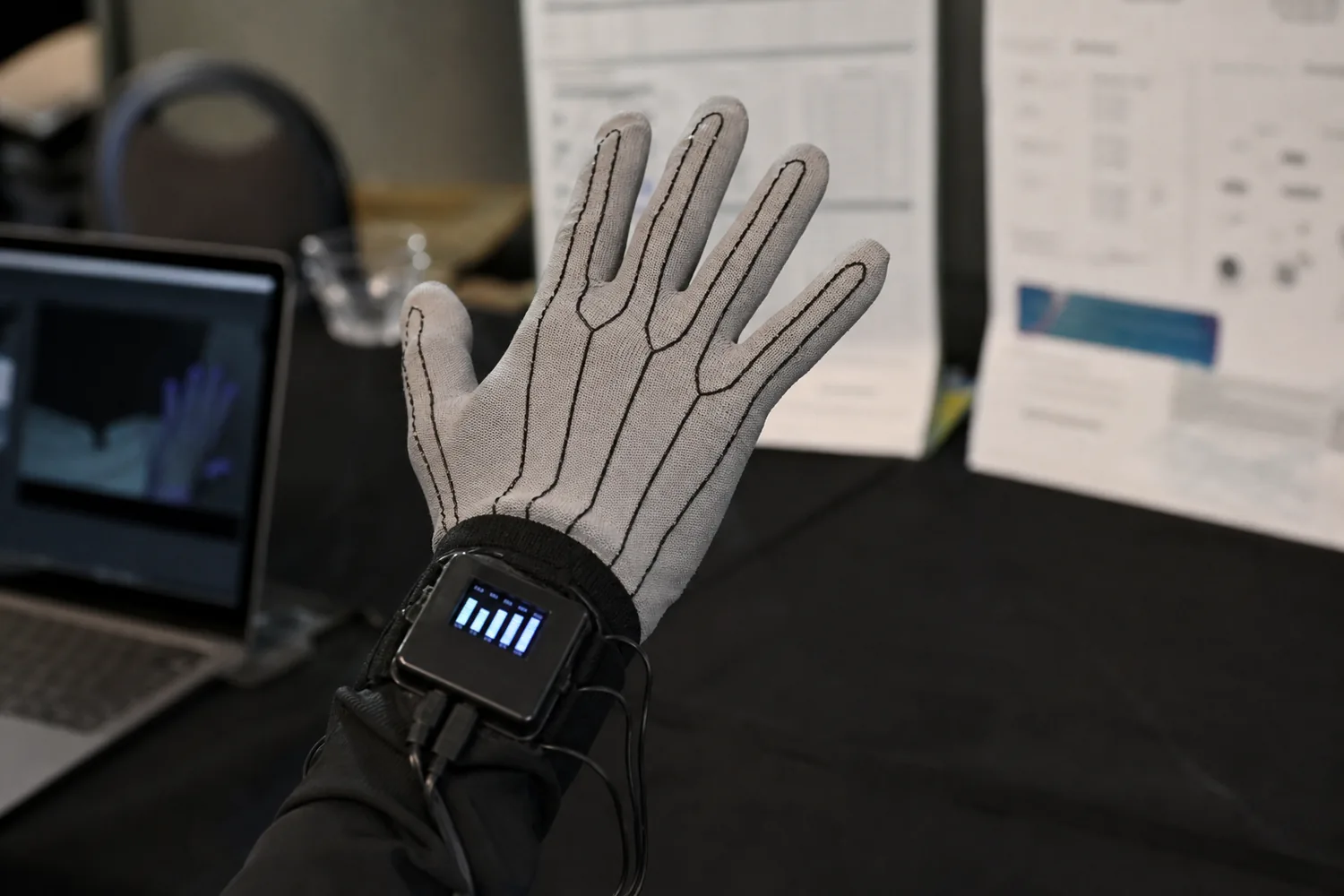
- Process
- Printed parts + lab-made traces
- Quantity
- 1 demo
- Region
- US lab
- Environment
- Conference booth
- Image
- Concept image, not to scale
Example brief · not client workWe wrote this brief ourselves; it is not client work. The design below is a hand-built CAD sample drawn to the concept sketch: it is not our engine's output, and it has not been built or tested physically.
The request, as a client would send it
Our lab develops a stretchable conductive ink. We want a glove that shows it working: five traces printed on TPU film, one along each finger, change resistance as the fingers bend, and a small screen on the wrist shows each finger's bend live. We will print and laminate the traces ourselves. We need everything else: the wrist module and its strap, a way to connect the soft traces to the rigid board that survives people trying the glove on all day, and anchors at the fingertips. Wrist module: an Arduino Nano 33 BLE (45 x 18 mm), a 500 mAh LiPo (about 35 x 30 x 5 mm) with a charger board, and a 0.96 inch OLED (27 x 27 mm module). We have all three. Each trace goes to an analog input through a divider. Please send the parts, instructions we can follow in the lab, and the code. It is for a conference booth, so it will be put on and taken off many times.
Attached by the client
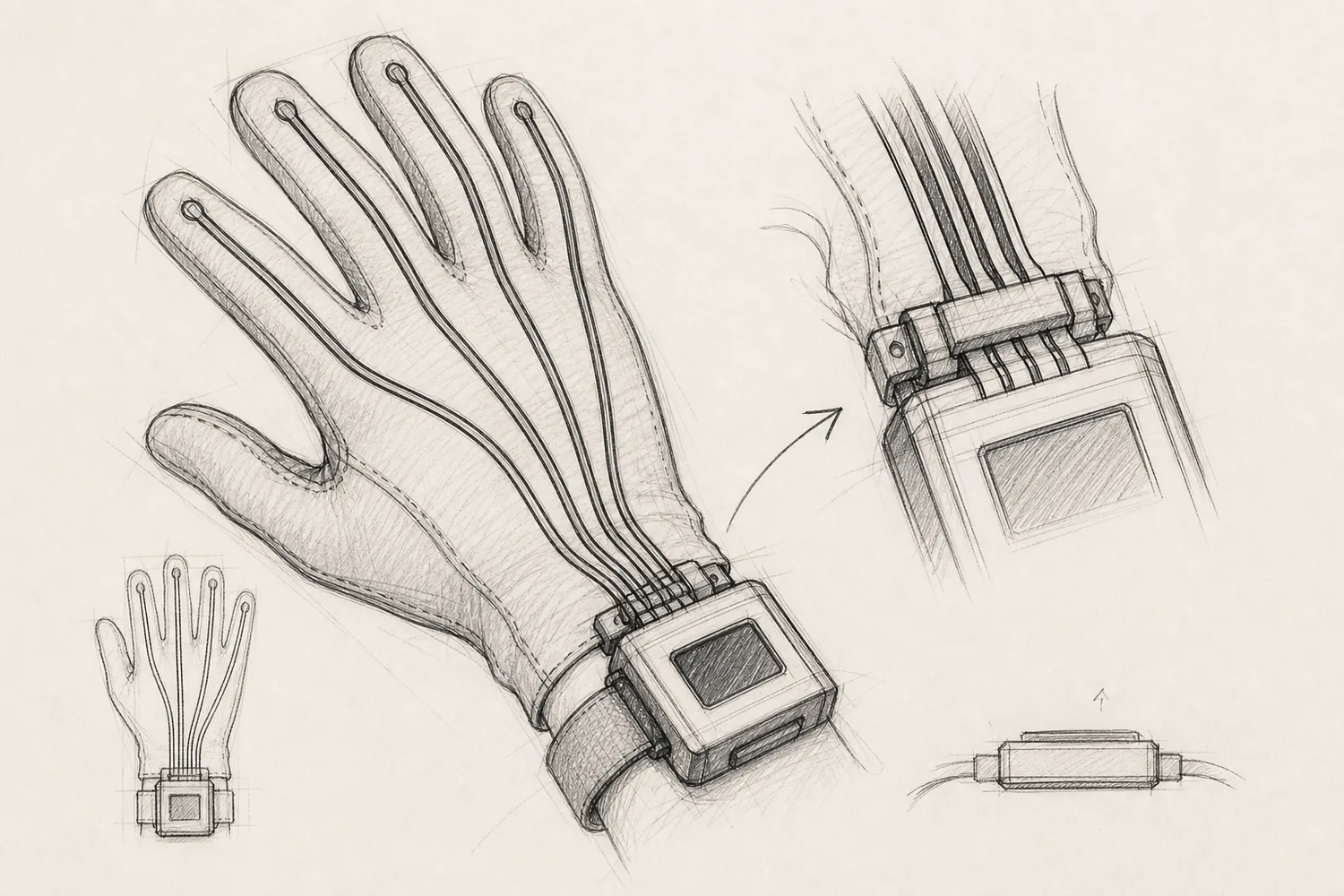
Links in the request
- Arduino Nano 33 BLE (opens in a new tab)45 x 18 mm board the lab already has
Product names are their owners' trademarks and are used only to describe size or parts.
Highlighted numbers came with the request; they are the values we would design to.
What we considered
| No. | Consideration | How it is checked |
|---|---|---|
| 01 | Soft traces meet a rigid board A clamp at the wrist presses each trace onto a contact pad, with strain relief so pulling the glove on does not load the joint. | Clamp fits the trace width and film thickness; strain-relief length listed. |
| 02 | The wrist module fits the parts the lab has Board, battery, charger and screen stack inside a module sized for a wrist, with the USB port and switch reachable. | Parts placed with clearance; port and switch access zones clear. |
| 03 | Many hands, all day The strap, the fingertip anchors and the clamp are designed to be put on and taken off again and again. | Anchor and strap geometry listed; wear is not tested. |
| 04 | Code and instructions the lab can run The code reads five dividers, calibrates each finger at start, and draws five bars on the OLED. | Pin map matches the wiring diagram; the code builds for the Nano 33 BLE. |
The question we would ask you
Should the glove also send the readings to a laptop?
Bluetooth to a laptop adds a small app on the lab's side and changes the code; the screen on the wrist alone keeps the demo simple.
What we do not claim
- Electrical performance of the lab's conductor
- Accuracy of the bend readings
- Wear or wash resistance
Sample CAD and the checks we ran
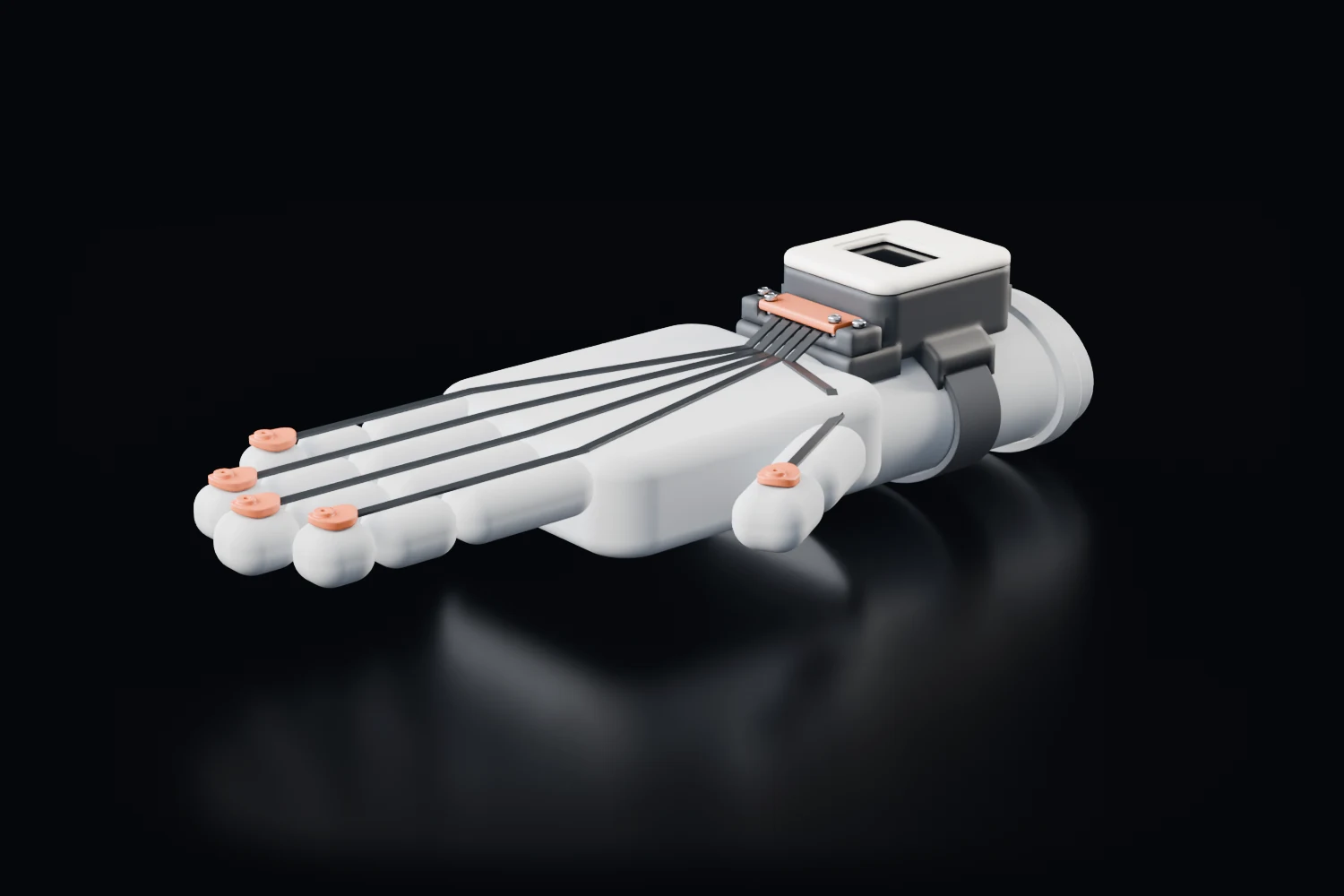
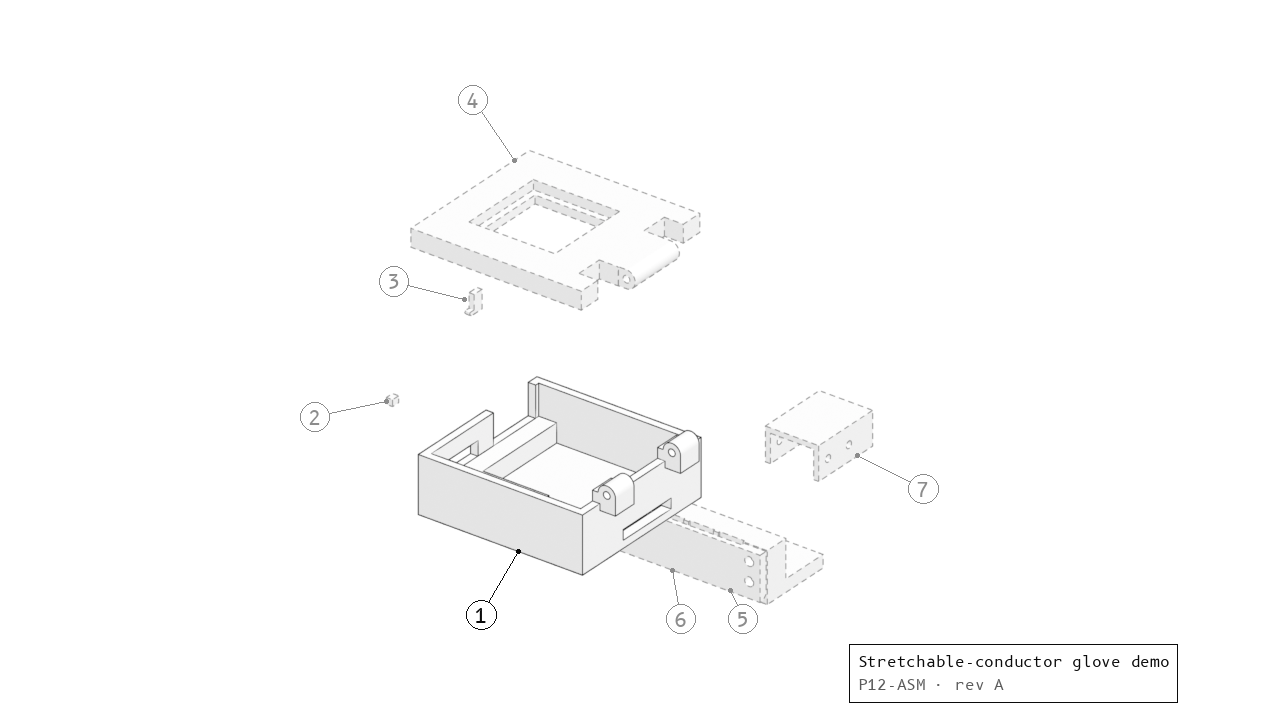
Sample designWritten by Anamor as a hand-built CAD sample for this page, drawn to the concept sketch. It is not our engine's output and it has not been built or tested physically.
P12-ASM
- 1Wrist module base
- 2LiPo cell 500 mAh
- 3Charger board
- 4Arduino Nano 33 BLE
- 50.96" OLED
- 6Screen lid
- 7Trace clamp base
- 8Contact pad strip
- 9Clamp cap
- 10M2 screw×4
- 11Hook-and-loop strap
- 12Fingertip anchor×5
Parts list · 19 parts
| No. | Part | Qty |
|---|---|---|
| 1 | Wrist module base | 1 |
| 2 | LiPo cell 500 mAh | 1 |
| 3 | Charger board | 1 |
| 4 | Arduino Nano 33 BLE | 1 |
| 5 | 0.96" OLED | 1 |
| 6 | Screen lid | 1 |
| 7 | Trace clamp base | 1 |
| 8 | Contact pad strip | 1 |
| 9 | Clamp cap | 1 |
| 10 | M2 screw | 4 |
| 11 | Hook-and-loop strap | 1 |
| 12 | Fingertip anchor | 5 |
What we measured on the sample
- Clearance at rest
- 0.50 mm smallest gapEvery pair of the 19 parts measured at rest (171 pairs); the value is the smallest gap found.
- Overall size
- 123.2 × 248.8 × 65.8 mmAssembled, x × y × z.
Not done yet
- Dimensioned part drawings
- Process rule inspection (wall, draft, bend and hole rules)
- A physical build