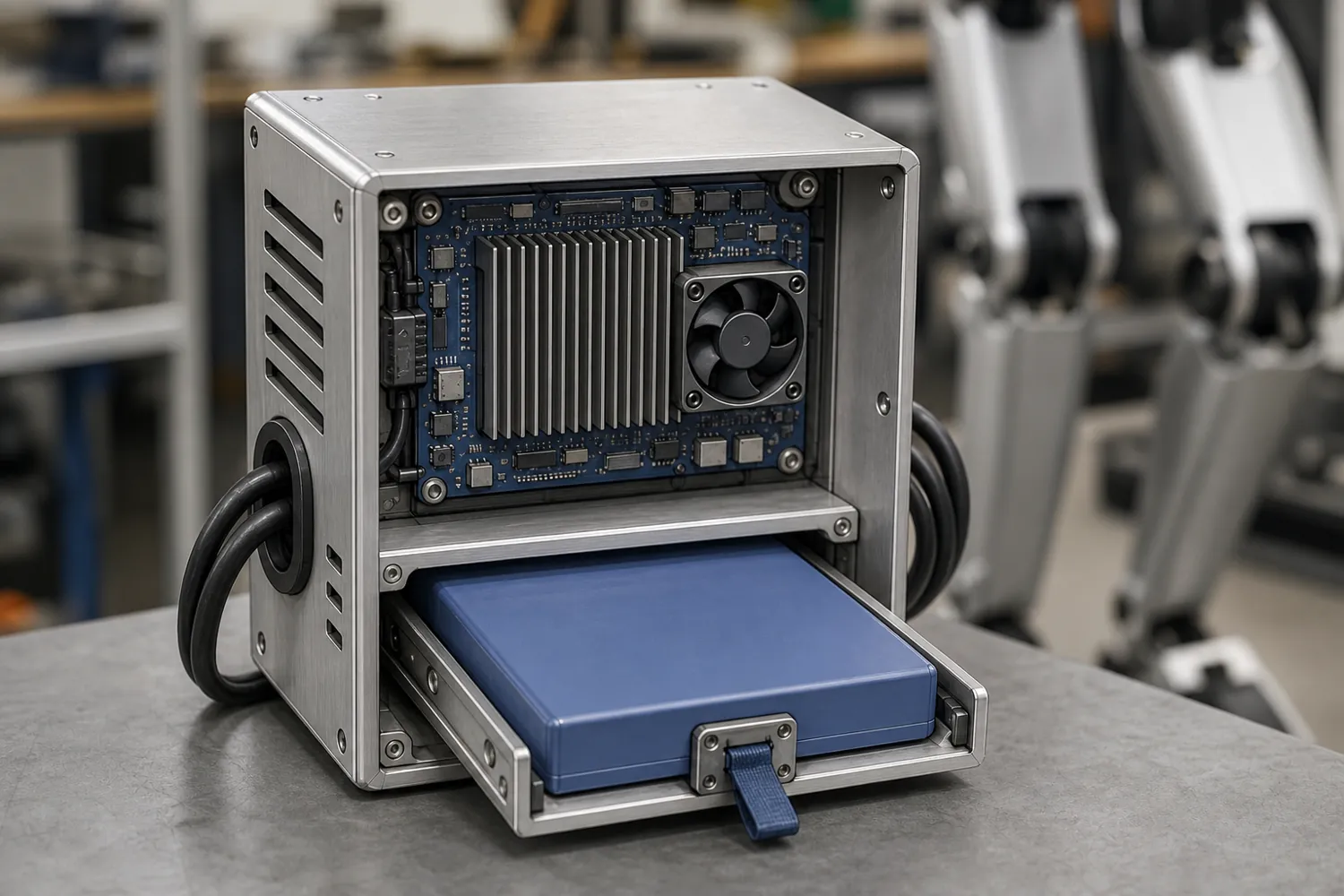
Humanoid torso battery and compute bay
A quick-release battery on rails and a cooled compute module in one torso bay.
- Process
- Sheet aluminium + CNC plates
- Quantity
- 10
- Region
- Global
- Environment
- Research robot
- Image
- Concept image, not to scale
Example brief · not client workWe wrote this brief ourselves; it is not client work. The design below was generated and checked by our engine as an internal test; read the notes under it before drawing conclusions.
The request, as a client would send it
Our lab builds a research humanoid, and we're redesigning the torso. We need a bay for the battery and the main computer: 10 units. - Battery: a quick-release pack (swapped with the robot powered down) of about 120 x 80 x 182 mm, similar to the Unitree G1 pack. It should slide out on rails and latch, without tools. - Compute: an NVIDIA Jetson Orin Nano developer kit, 100 x 79 x 21 mm, with an extra 40 mm fan pulling air from side vents to a rear exhaust. - Cables to both arms and both hips leave through rubber grommets on the left and right. A sheet aluminium frame, with machined mounting plates where the torso structure bolts on. For context, Unitree's G1 uses a quick-release battery; we want the same convenience in our own layout. Our sketch of the bay is attached.
Attached by the client
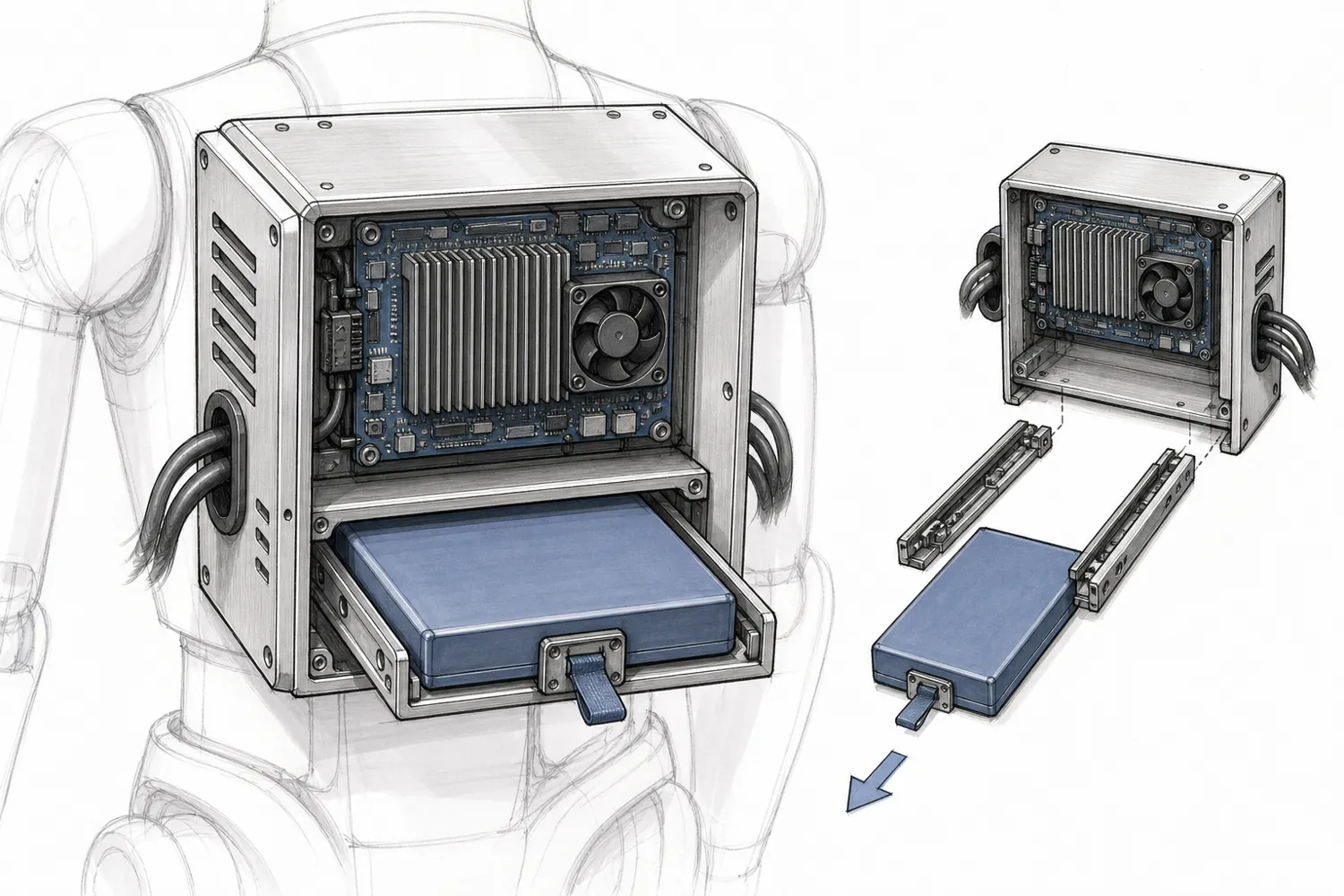
Links in the request
- Jetson Orin Nano Developer Kit (SparkFun) (opens in a new tab)100 x 79 x 21 mm
- Unitree G1 battery pack (reseller) (opens in a new tab)120 x 80 x 182 mm, quick-release
- Unitree G1 (context) (opens in a new tab)research humanoid with a quick-release battery
Product names are their owners' trademarks and are used only to describe size or parts.
Highlighted numbers came with the request; they are the values we would design to.
What we considered
| No. | Consideration | How it is checked |
|---|---|---|
| 01 | A battery that slides out and latches Rails with running clearance, a latch, and room behind the pack to pull it out without tools. | Pack fits its rails; clear zone in the removal direction. |
| 02 | Compute gets its own air Side vents, the module's heatsink, the 40 mm fan and the rear exhaust line up without the battery in the way. | Clear path from intake to exhaust. |
| 03 | Cables leave without chafing Grommeted openings on both sides with room for the cable bend radius. | Opening sizes and clear zones behind them. |
| 04 | Two processes, one bay A bent aluminium frame with PEM nuts, plus machined plates where the torso bolts on. | Sheet-metal rules on the frame; hole alignment with the plates. |
The question we would ask you
Should the battery come out of the back or the bottom?
It decides where the rails and latch go, and whether the robot must be lifted or turned to swap packs.
What we do not claim
- Battery safety certification
- Thermal analysis
- Design of the rest of the robot
From request to checked design
-
1 · Request
A quick-release battery on rails and a cooled compute module in one torso bay.
Plain-language brief with 3 links and a sketch. Only the text goes into the pipeline.
-
2 · Brief card
6 parts to make4 parts to fit15 pass criteria
Assumed
- Quantity 10 as stated; sheet metal batch confirmed.
- Material 5052-H32 aluminium, 2 mm sheet frame, 8 mm 6061 machined mounting plates (typical for bolted structural interfaces).
- Overall envelope capped at 300 x 220 x 260 mm — smallest box that holds battery + compute + fan duct with wall and rail allowances.
- and 4 more
Asked
- Does the battery slide out upward, or forward/rearward from the torso?
- What is the bolt pattern and hole size on the torso structure for the machined plates?
- and 1 more
-
3 · Design
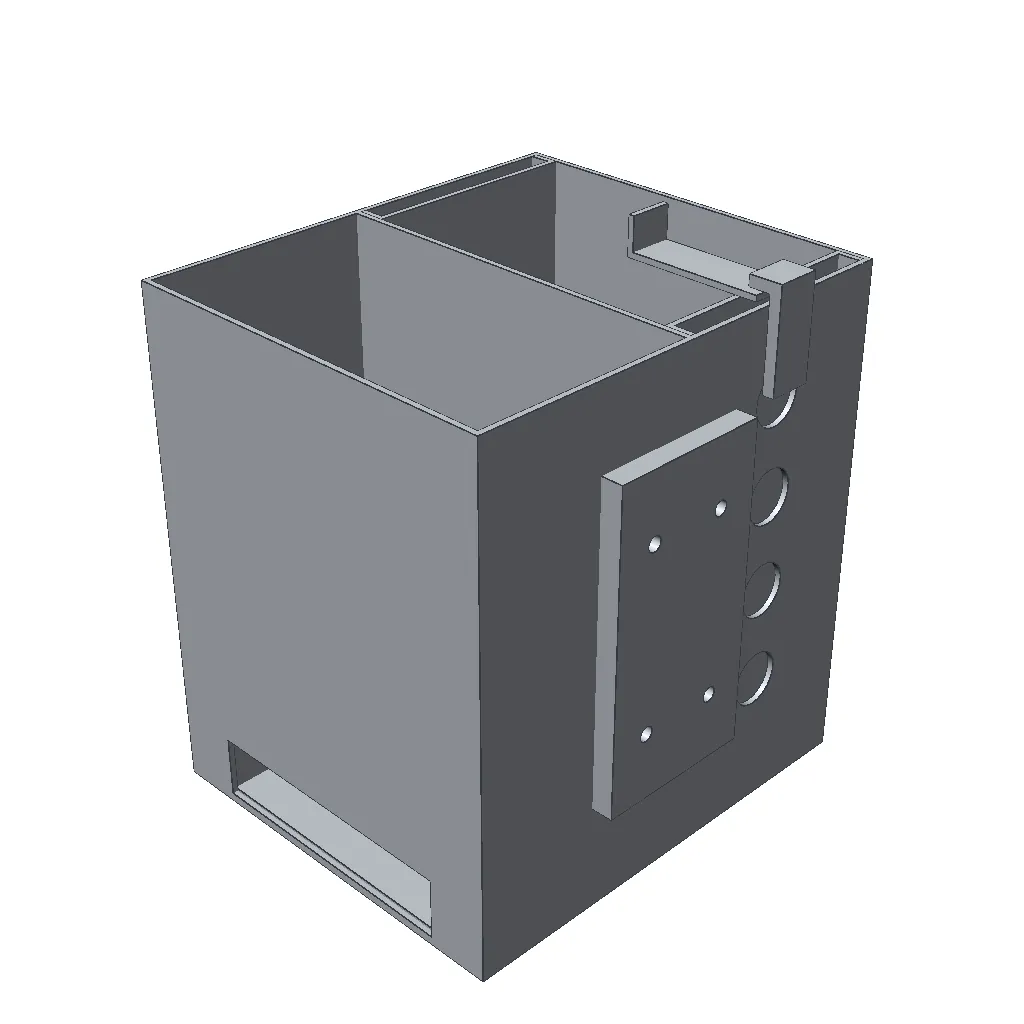
Sheet aluminium, machined plates
frame shell × 1 · battery rail × 2 · spring latch × 1 · compute tray × 1 · mounting plate × 2 · fan shroud × 1
Engine output. Untextured CAD render.
-
4 · Check
15checks passed0checks failing0checks not measured
Measured
- Closed solids
- Overall size
- Cavity size
- Part fits with clearance
- Holes and bosses
- No two parts overlap
- Part inside the envelope
- Clear zone in front of a part
- Part can be removed
- Latch engages
Counts cover checks that exist; the notes below list what has no check yet.
Failures go back to the design stage with the numbers; earlier failures stay on record.
-
5 · Scene
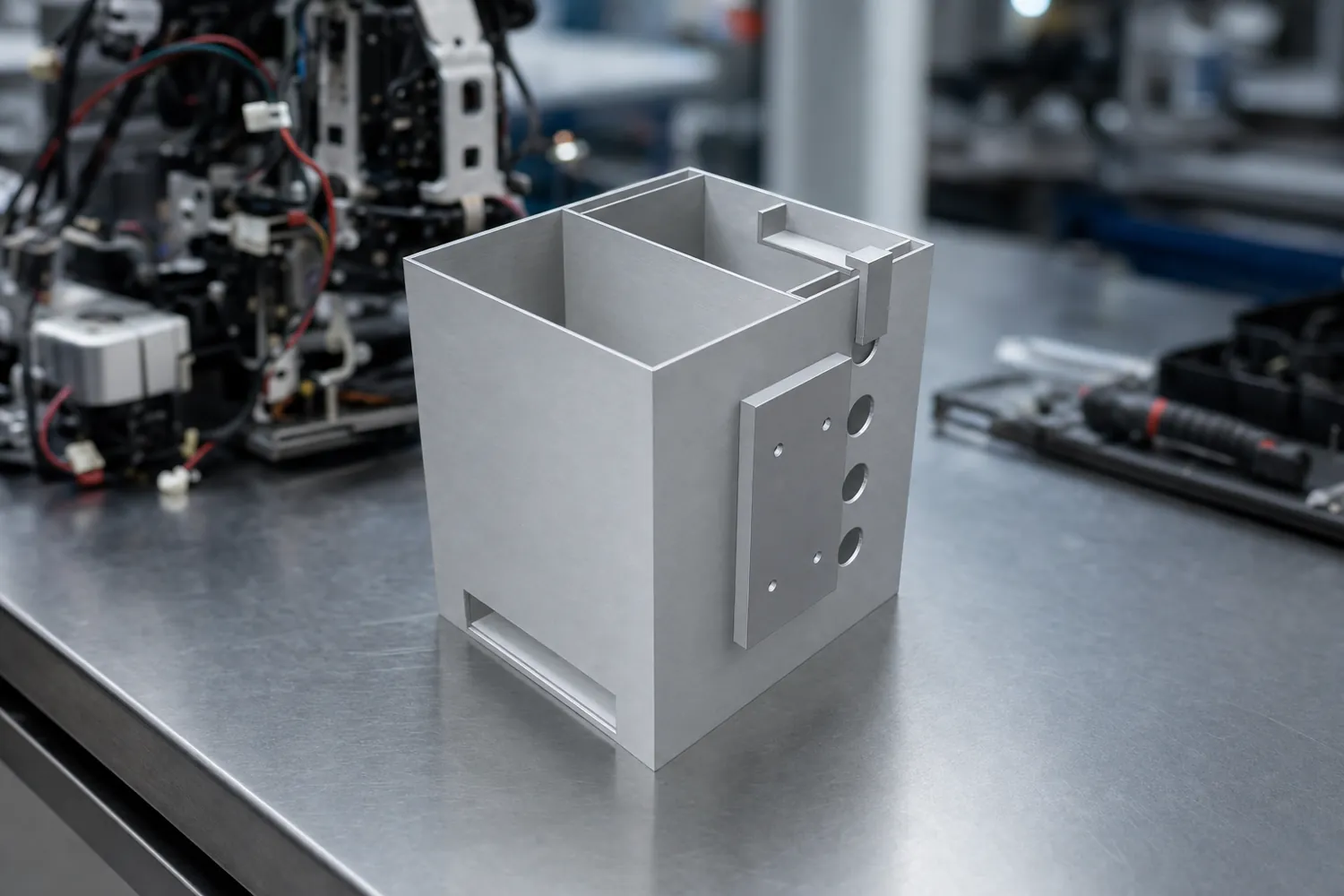
AI-generated from the CAD render above: same shape, only material, light and background added. Not to scale.
- Our checker counted each pair of facing cable holes as one, so the first check reported only two holes. The fixer then doubled the holes to eight to pass. This is a checker defect; the design should have four.
- No sheet-metal checks ran: bends, reliefs, PEM nuts and flat patterns are not measured yet and are not in the counts above.
- The battery was made to slide out upward, while the brief's default answer is out of the back. The pipeline did ask the question.
- Side intake vents for the compute module were not modelled.
Run on 2026-09-29 with our in-house engine as an internal test. Drawings and BOM for this case are not produced yet.