Outdoor LoRa sensor node
A pole-mounted IP65 housing that farmers open once a year.
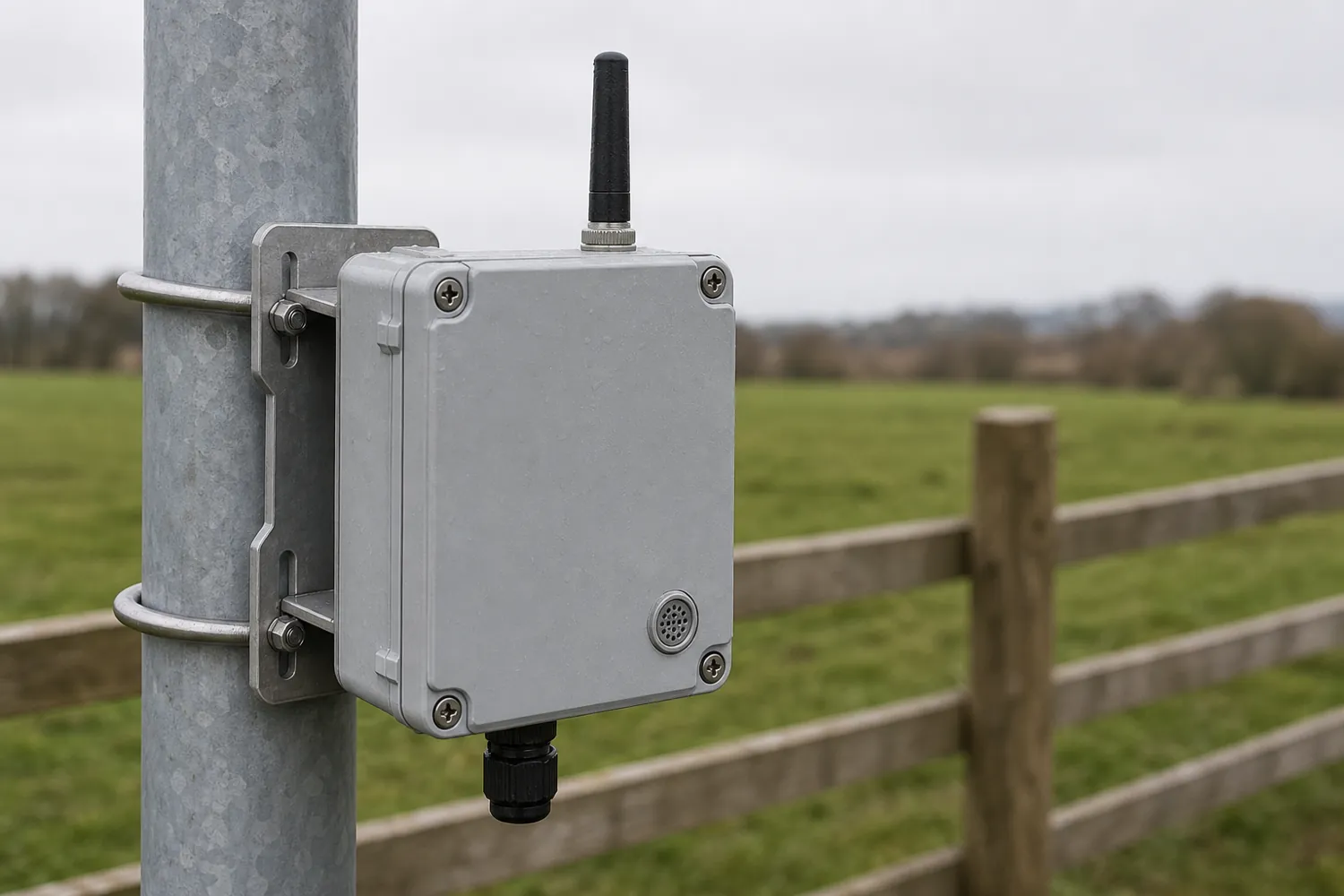
- Process
- Printed ASA + stainless sheet
- Quantity
- 50
- Region
- Global
- Environment
- Outdoor, UV, −20 to 50 °C
- Image
- Concept image, not to scale
Example brief · not client workWe wrote this brief ourselves; it is not client work. The 3D model, drawings and inspection results are in production and will replace the placeholders below.
The request, as a client would send it
We monitor soil moisture and canal water levels on farms. Today our nodes live in off-the-shelf grey boxes (similar to Hammond's 1554 series) with holes drilled by hand, and water keeps getting in around the antenna and the cable. We want a custom housing for 50 units this season. Inside: our 80 x 60 mm LoRa PCB and one 3.6 V D-cell lithium battery in a holder. Nothing else. On the outside: - an N-type bulkhead for a small stub antenna (we use Amphenol 172106) - one M16 cable gland for a sensor cable of 4.5 to 10 mm (LAPP SKINTOP M16) - a screw-in breathable vent, M12 (GORE) The node mounts on steel poles 40 to 60 mm in diameter, in full sun, -20 to 50 °C, with sprinklers twice a day. We are aiming for IP65. The pole bracket can be stainless sheet with U-bolts. Farmers open the lid once a year to change the battery, so the lid screws should be captive and the gasket should stay in its groove when the lid comes off. Printed ASA is fine for this batch; we may move to injection molding next year. A sketch of what we have in mind is attached.
Attached by the client
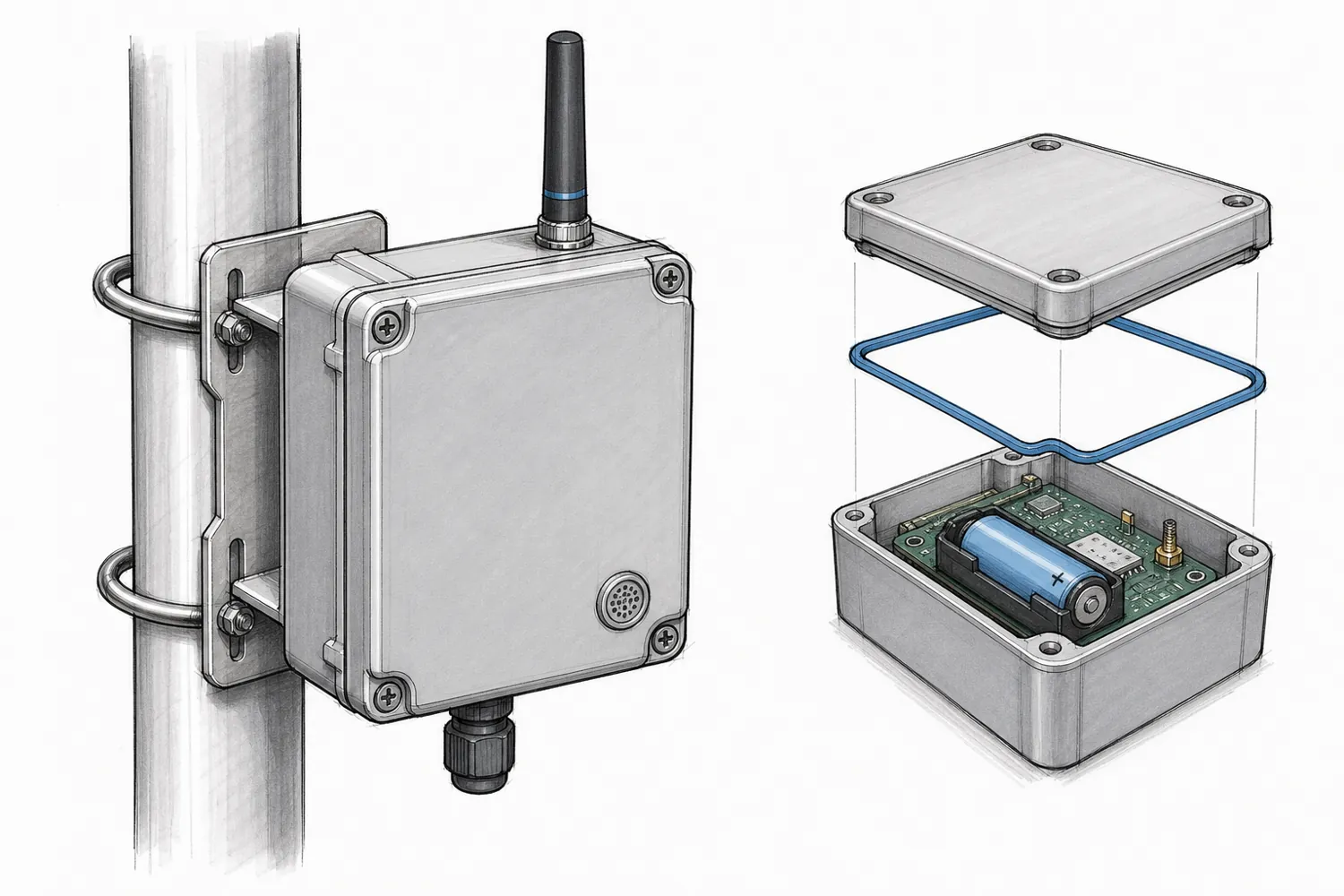
Links in the request
- Hammond 1554 series (current box, look reference) (opens in a new tab)IP66-rated off-the-shelf enclosures
- Amphenol RF 172106 N-type jack (opens in a new tab)panel-mount, 50 ohm
- LAPP SKINTOP GRIP M16x1.5 (opens in a new tab)4.5–10 mm cable, 20 mm wrench
- GORE screw-in protective vents (opens in a new tab)M12 thread variant
Product names are their owners' trademarks and are used only to describe size or parts.
Highlighted numbers came with the request; they are the values we would design to.
What we considered
| No. | Consideration | How it is checked |
|---|---|---|
| 01 | A gasket that stays put A groove in the base holds the gasket at about 25 % compression, so it stays in place when the lid is off. | Groove and lid land sized for the gasket's compressed height. |
| 02 | Room to tighten the gland and the vent The M16 gland and M12 vent sit where a 20 mm wrench and fingers can reach their nuts inside and out. | Hole sizes; clear zone around each nut. |
| 03 | Two processes in one assembly A printed ASA housing and a bent stainless bracket with U-bolts for 40–60 mm poles. | Bend radius and hole-to-bend distance on the bracket; bolt holes line up. |
| 04 | Materials picked by the environment UV and sprinklers push the housing to ASA and the bracket to stainless; the reason is written on the brief card. | Recorded as a decision with its reason. |
The question we would ask you
Should the antenna come out of the top or the side?
The top is better for range but is where water sits; the side is drier but shadows the antenna against the pole.
What we do not claim
- An IP65 rating (we design toward IP65; a test lab rates it)
- Radio range
CAD, drawings and inspection
Model, drawings, parts list and inspection report
The 3D model, dimensioned drawings, flat patterns, parts list, and the first-try and final inspection results will appear here after the first build. First-try failures stay visible.